Must-Have Experiences in the Douro Valley
Between schist terraces and the golden shimmer of grapes, the Alto Douro Wine Region holds centuries of history, silence, and a wine the whole world desires.
There are places that cannot be explained — only felt. The Douro Valley is one of them. Running along the banks of the Douro River, which rises in Spain and flows into the Atlantic near Porto, the landscape gradually transforms into something that defies any attempt at description: ancient schist terraces carved by human hands, vines growing in orderly rows down the hillsides, and a river that seems to appear from every angle at once.
The oldest demarcated wine region in the world — this title, granted in 1756 by the Marquis of Pombal, is not merely a historical curiosity. It is the cornerstone of an identity that has shaped generations of Douro people and made Portugal known across the globe through a single nectar: Port Wine.
A Landscape Shaped by Human Hands
What makes the Douro truly singular is the symbiosis between nature and human labour. The schist hillsides, inherently hostile to cultivation, were transformed over centuries into sloping terraces that capture every available ray of sunlight. Miguel Torga, the writer who loved this land most, called it a “geological poem” — and it was no exaggeration.
“The Douro has mountains that never stop growing, vines that no one can count, olive trees that live in prayer, and a river that never stops running.” — João de Araújo Correia
The region is divided into three distinct sub-regions: to the west, the Baixo Corgo, cooler and more humid; in the centre, the Cima Corgo, the heart of Port Wine, where Pinhão is located; and to the east, the Douro Superior, with scorching summers and almost desert-like landscapes stretching all the way to the Spanish border.

What to See and Do
Pinhão is, for many, the beating heart of the Valley. Nestled between the Douro and Pinhão rivers, this village is surrounded by historic estates and offers some of the most breathtaking viewpoints in the region. Its railway station, decorated with azulejo tile panels depicting life in the vineyards, is itself an open-air museum not to be missed.
The N222 road, linking Peso da Régua to Pinhão along the southern bank of the river, has been considered one of the most beautiful in the world. It spans 27 kilometres with 93 bends, each one revealing a different perspective over the valley. Driving it slowly and attentively is an experience that stays with you long after.
In Peso da Régua, the Douro Museum offers a deep dive into the history and identity of the wine region — from the rabelo boats that once carried barrels of wine to modern winemaking techniques. For first-time visitors to the region, it is the ideal starting point.
Not far away, in Lamego, the Sanctuary of Nossa Senhora dos Remédios rises 600 metres above the ground, with a baroque staircase of 686 steps that is one of the most celebrated on the Iberian Peninsula. The city combines stunning monuments with irresistible gastronomy — Lamego’s cured hams and sparkling wines are not to be missed.
Travelling by River and Trail
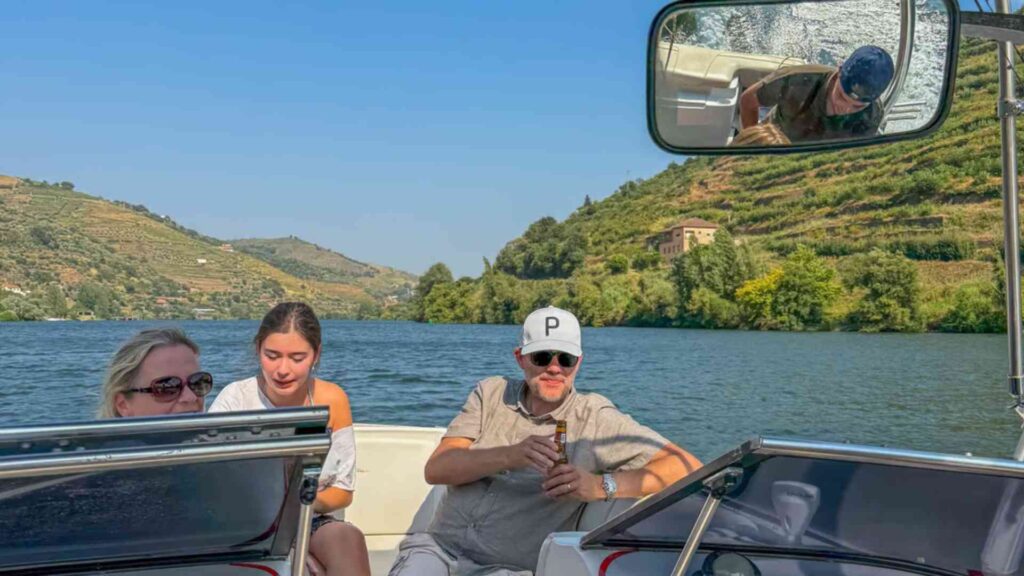
One of the most memorable experiences in the Douro is sailing the river. River cruises — which can last from one hour to an entire week — allow you to admire the terraces from an angle no road can offer. The rabelo boats, traditional vessels that once carried wine barrels, still glide along the Douro’s waters as witnesses to a different era.
Those who prefer the train will find in the Douro Line one of the most beautiful rail journeys in Portugal. Departing from Porto, the carriages travel over 200 kilometres through the valley, crossing bridges, tunnels and soulful stations, all the way to Pocinho. Getting off at Pinhão and simply standing there gazing at the river is, according to many travellers, one of the simplest and most powerful things Portugal has to offer.
Harvest Season: When the Douro Celebrates
If there is one ideal time to visit the Douro, it is September and October. The harvest — the grape picking — transforms the entire region into a moment of collective celebration. The estates open their doors, the sweet scent of grapes fills every lane, and the work that has sustained generations repeats itself with the same seriousness and joy as ever. Taking part in a harvest is to touch the soul of the Douro.
The Douro Valley is not just a destination. It is an argument in favour of the beauty that grows from the relationship between a people and their land. It is a reminder that the best places in the world are not visited with the eyes alone — they are visited with feet on the ground, a glass in hand, and silence as company.
Bambuti Experiences
Bambuti plays a meaningful role in the development and promotion of tourism in the Douro. Through the organisation of authentic and personalised experiences — such as boat trips on the Douro River, visits to traditional estates, wine tastings, outdoor activities and cultural itineraries — the company provides visitors with a direct and unique connection to the essence of the region.
These activities celebrate not only the natural beauty of the Douro, but also its history, local traditions and the work of communities tied to wine production. By collaborating with local producers, guides and businesses, Bambuti helps to energise the regional economy, creating opportunities and encouraging sustainable tourism.
Come celebrate the Douro with us!

- 8 Hours
- Pickup point: hotel / accommodation
- 185.00€